https://www.resolutionfoundation.org/publications/saving-private-renters/
Local Housing Allowance (LHA), which caps how much support is provided through the social security system to low-income private renters, was last relinked to the 30th percentile of rents in April 2024, and has been frozen in cash terms ever since. But private rents have risen considerably since then. [1] A low-income family renting a typical two-bedroom home faces a shortfall of £158 a month, and the gap between average rents at the lower end of the market and the housing support a private renter can receive via the benefit system is set to reach a record high of 23 per cent this October.
Governments of various persuasions have claimed that LHA rates feed through to rents, inhibiting policy makers from relinking housing support in the fear that the increase would pass through to landlords. But new analysis of the April 2024 LHA uplift suggests only a small share of increased support is captured by landlords, with a central estimate of around 10p in every pound of the uplift feeding through to higher rents at the bottom of the market. Consistent with this, the share of low-income private renters whose LHA fell short of their rent dropped from 67 per cent just before the LHA increase to 46 per cent a year later, and was still below its pre-uplift value in May 2026.
These findings strongly suggest that relinking LHA to rents at the 30th percentile mainly benefits low-income tenants, and that only a small part leaks into higher rents. This mirrors DWP-commissioned research on the 2011 cut to LHA, which found that around 90 per cent of that policy change fell on tenants. As a result, the Government should commit to relinking LHA to the 30th percentile of local rents on an annual basis at the Autumn Budget. This comes with a cost of £2 billion a year by the end of the Parliament but, if necessary, could be funded by increasing the Universal Credit taper.
The gap between Local Housing Allowance and market rents will hit a new high this autumn
The rising cost of living has hit many households hard in recent years and shows no signs of abating. But lower-income private renters have had to contend not just with the rising price of energy, food and other essentials, but also with increasingly burdensome housing costs as the amount of housing support they receive from the state has shrunk relative to rents.
Local Housing Allowance (LHA) determines the maximum amount of help that the 1.9 million privately-renting households in Great Britain on Universal Credit (UC) or Housing Benefit (HB) can receive from the state with their rental costs. LHA caps the amount of benefit paid for each property size in each of the 192 Broad Rental Market Areas (BRMAs) in Great Britain. When first introduced in 2008, LHA was set at the median rent for each local area and increased in line with local rents. In 2011, LHA was cut from the median rent to the 30th percentile of rents. The automatic link to market rents was ended a year later, and rates have been frozen in nine of the past 14 years. But rents continue to rise when rates are frozen, meaning every month the LHA covers a little less of the market rent.
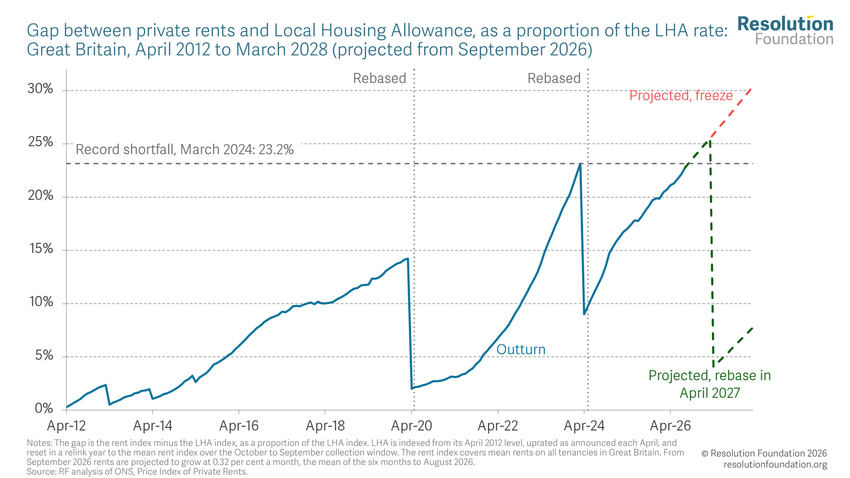
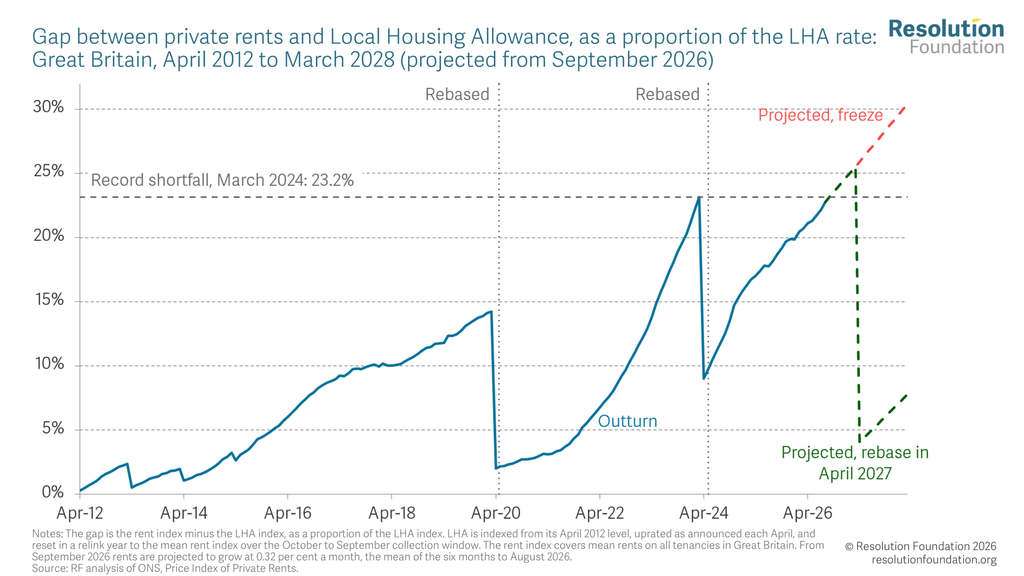
The impact of this is shown in Figure 1. By March 2020, four years into a cash freeze, LHA had fallen 14 per cent below the 30th percentile of rents, on average. The April 2020 one-off rebase closed that gap, but rates were then frozen again and, by March 2024, rapid rent inflation had widened it to 23 per cent. Rates were re-linked to the 30th percentile again in April 2024, but have been frozen since.[2] Rents have continued to climb since: by August 2026 the gap had reached almost 23 per cent, close to the March 2024 record.[3] Across England, the rent of a two-bedroom home at the 30th percentile now sits £158 a month on average above the LHA rate.[4] Small surprise, then, that in July 2026, Crisis and Citizens Advice estimated that fewer than 2 per cent of homes listed for rent in Great Britain could be covered by LHA alone.